

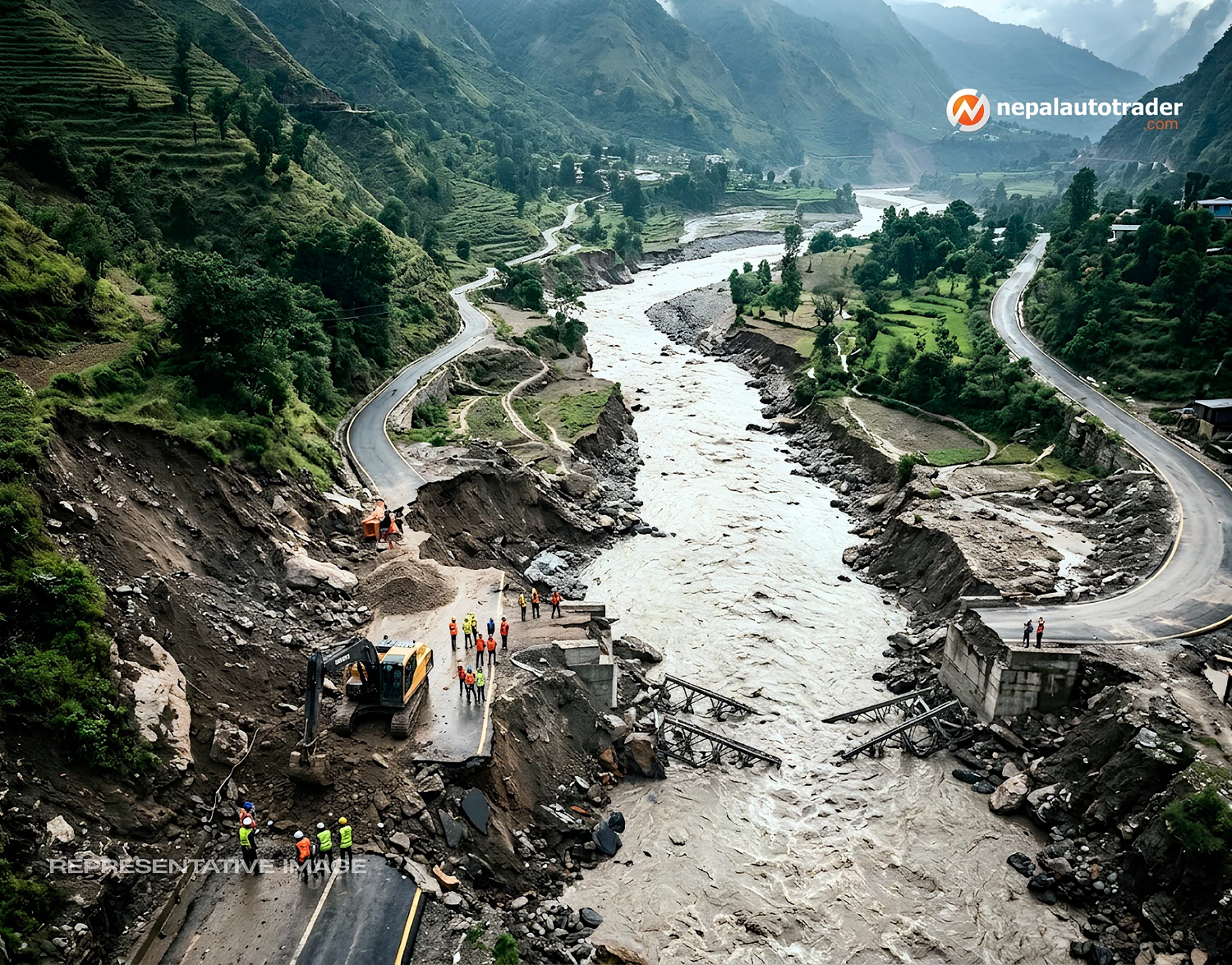
Road repairs have moved into emergency territory after flooding caused extensive damage across some of Nepal's most important transport links. The Department of Roads has allocated Rs 32.5 million to begin urgent restoration work, with the immediate focus on routes connecting the central hills, the northern border and the western highway network.
The decision comes after flooding in the Bhotekoshi area caused severe damage on the Galchhi-Betrawati-Rasuwagadhi corridor and the Galchhi-Mugling section of the Prithvi Highway. For motorists, freight operators and communities along these corridors, this is not simply a road maintenance issue. It is a question of access.
The scale of the damage explains the urgency. According to the Department of Roads, 40 km of the 56 km road between Vidur and Rasuwagadhi has been completely washed out. The Prithvi Highway has also suffered major river erosion at Krishnabhir and Parewabhir.
That combination puts pressure on almost every type of road user, from passenger vehicles and buses to freight trucks and emergency services.
Repairing washed-out road surfaces is only part of the problem. Bridges have also taken a heavy hit, leaving several communities without normal road connectivity.
The Department of Roads says flooding damaged 31 motorable bridges across Rasuwa, Nuwakot and Dhading. Instead of waiting for permanent structures to be rebuilt, authorities have started the process of installing Bailey bridges at three locations.
| Location | Recovery Action | Current Detail |
|---|---|---|
| Devighat | Bailey bridge | A 50 metre bridge is being prepared at Tadi Khola |
| Trishuli Bazaar | Bailey bridge | Design completed for installation |
| Betrawati | Bailey bridge | Design completed for installation |
The temporary structures matter because bridges can become the bottleneck even after nearby road sections are cleared. A repaired approach road is of little use if vehicles still cannot cross the river. In that sense, the Bailey bridge programme is one of the most practical parts of the immediate response.
Permanent reconstruction will take longer. For now, connectivity comes first.
The damage is already reshaping travel patterns. Authorities have brought a 110 km alternative road into use for travel from Kathmandu toward Dhunche, following the Tokha-Chhahare-Vidur-Bogtitar route.
Another disruption has emerged after the bridge at Phurke Khola was broken, affecting the road connection toward Dhadingbesi. Traffic has been redirected through Maltatar, Gajuritar and Kewrinighat.
These diversions are more than a temporary inconvenience. Longer routes mean additional travel time, higher operating costs and greater pressure on roads that were not necessarily designed to absorb sudden increases in traffic.
The situation around Krishnabhir illustrates the problem particularly well. The Department of Roads is considering whether to cut into the hillside or construct a new track from the opposite side of the Trishuli River. Officials are consulting experts from the Nepal Geotechnical Society before deciding how to proceed.
That decision will matter. A rushed opening could create another failure point in terrain that is already unstable.
The response has already moved beyond assessment. More than 50 senior technicians, engineers and mechanics have been deployed across the affected work areas, while the department has mobilised more than 15 pieces of heavy equipment.
That combination gives the recovery effort a substantial field presence, but the physical scale of the damage remains the bigger challenge. Clearing debris, stabilising slopes, restoring road formations and reconnecting bridges are very different tasks, often happening at the same time.
The response therefore has two tracks: reopen what can be reopened quickly, while gathering the engineering information needed for more durable reconstruction.
Nepal's road network is unusually sensitive to disruption because major corridors often serve several purposes at once. A highway can be a commuter route, a freight connection, an access road for remote communities and a critical link for emergency response.
The current disruption has already pushed traffic onto alternative corridors. Earlier reports showed increased vehicle pressure on routes connecting Kathmandu with Hetauda after the Krishnabhir failure. Read the latest report on alternative Prithvi Highway routes
That pressure can quickly become a secondary infrastructure problem. More vehicles on longer, narrower or more winding roads can increase congestion and operating strain. For commercial transport, every additional kilometre also has a cost.
The situation in Nuwakot shows the other side of the equation. A road reopened across the Trishuli River has restored transport access for communities beyond the river and made it easier to move rescue supplies, relief materials and other essentials. Read how Nuwakot's road connection was restored
This is where infrastructure recovery becomes a mobility story. The road is not the end product. Connectivity is.
The immediate target is clear: restore movement as quickly as conditions safely allow. The Department of Roads has already started the process at the three Bailey bridge sites, while technical teams continue examining other damaged structures.
| Area | Damage or Requirement | Response |
|---|---|---|
| Vidur-Rasuwagadhi | 40 km of the 56 km section washed out | Road restoration underway |
| Prithvi Highway | Major erosion at Krishnabhir and Parewabhir | Technical assessment and reopening discussions |
| Rasuwa, Nuwakot and Dhading | 31 motorable bridges damaged | Surveys and bridge restoration planning |
| Devighat | Bridge crossing required | 50 metre Bailey bridge preparation |
| Trishuli Bazaar and Betrawati | Bridge connectivity disrupted | Bailey bridge designs completed |
The recovery effort will also have to contend with the geography itself. At Krishnabhir, for example, officials are weighing competing engineering solutions because the surrounding terrain remains difficult. Opening a road is one thing. Keeping it open through the next heavy rainfall is another.
The broader road network is already carrying the consequences. Read about traffic pressure on Kathmandu-Hetauda routes
For motorists, freight operators and residents in the affected districts, the meaningful measure of this Rs 32.5 million allocation will not be the announcement itself. It will be the moment a damaged road becomes dependable again, a bridge carries traffic safely, and an emergency detour finally becomes unnecessary.
That is the real challenge now. Not simply repairing roads, but restoring confidence in the routes that connect people, goods and emergency services across some of Nepal's toughest terrain.
Q: How much has been allocated for the damaged roads?
A: The Department of Roads has allocated Rs 32.5 million for urgent repair work on the damaged road corridors.
Q: Which roads are covered by the repair allocation?
A: The allocation covers the Galchhi-Betrawati-Rasuwagadhi road and the Galchhi-Mugling section of the Prithvi Highway.
Q: How badly was the Vidur-Rasuwagadhi road damaged?
A: Of the 56 km section between Vidur and Rasuwagadhi, 40 km was completely washed out by the flood.
Q: Where are Bailey bridges being installed?
A: The Department of Roads has begun the process at Devighat, Trishuli Bazaar and Betrawati. A 50 metre Bailey bridge is being prepared at Tadi Khola in Devighat.
Q: What alternative route can be used toward Dhunche?
A: A 110 km alternative route through Tokha-Chhahare-Vidur-Bogtitar has been brought into use for travel from Kathmandu toward Dhunche.
Q: When will all damaged roads and bridges be fully restored?
A: The source does not provide a final completion date. Technical surveys, road repair work and Bailey bridge installation are currently progressing across the affected areas.

Nepal Auto-Trader is one-stop platform for all automotive needs. We provide unbiased and unparalleled news/reviews of all auto-motives being launched in Nepalese Auto-Industry. Find recent updates and price of bikes/cars, compare and review recently launched bikes/cars, buy/sell/trade reconditioned cars/bikes and all government news about changing rules and regulation, road safety by subscribing us.

Subscribe to our Newsletter
© Copyright 2026, Nepal Autotrader



.png)
.png)